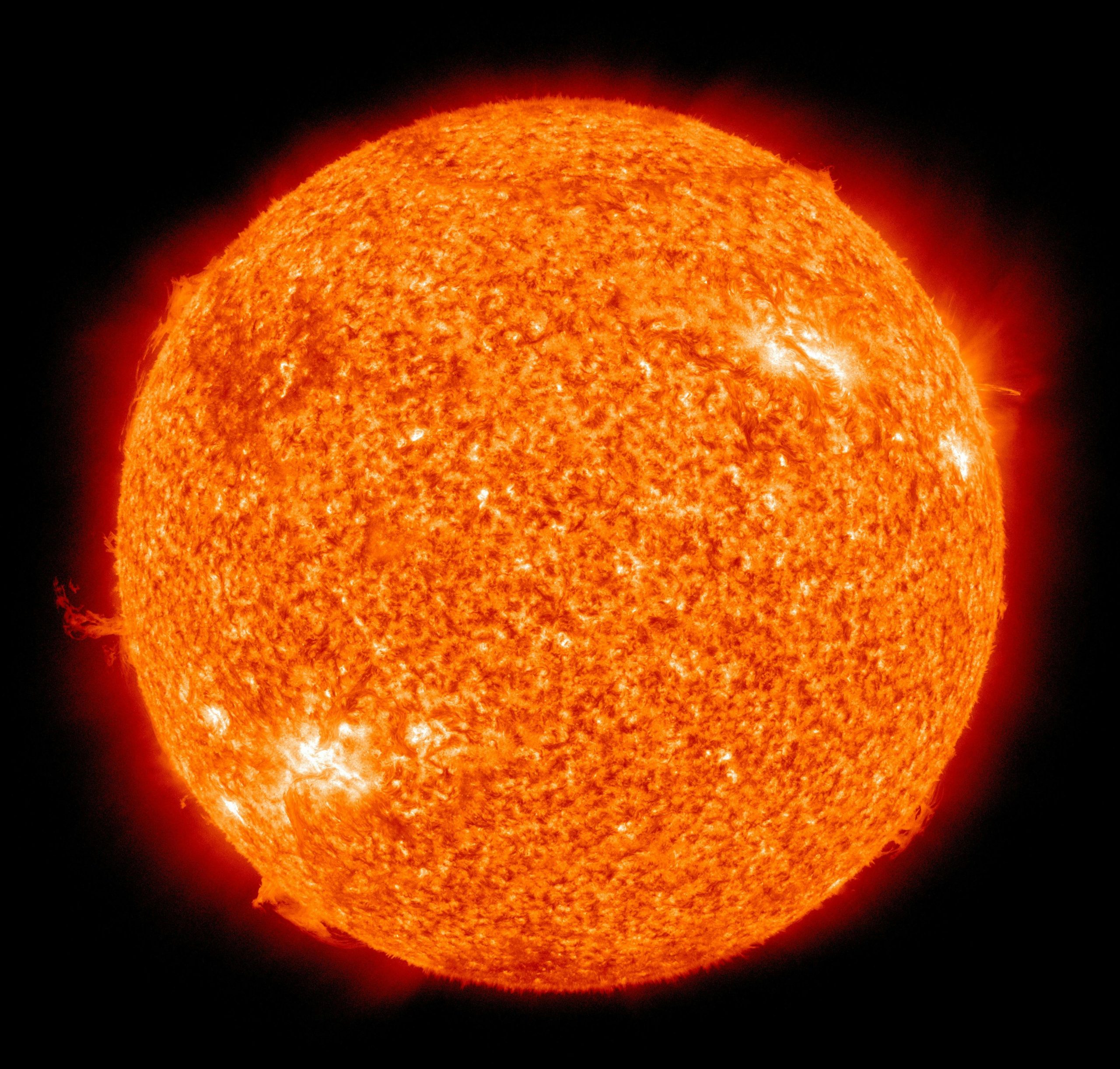
Short answer: With our present technology, no one has produced a laboratory plasma that is truly superconducting. The two physical conditions that favour plasma formation (very high temperatures that rip electrons off their atoms) clash head-on with the conditions that favour superconductivity (very low temperatures or extremely dense, highly ordered quantum states). There are exotic regimes—metallic hydrogen deep inside giant planets, and colour-superconducting quark matter in neutron-star cores—where a “plasma” can in principle carry current without resistance, but recreating those states on Earth for more than microscopic flashes is still beyond reach.
Why the concepts pull in opposite directions
| Property | Ordinary plasma | Superconductor |
|---|---|---|
| Temperature | ≥ 10^3 K to keep atoms ionised | ≪ 100 K for conventional materials (some hydrides reach ~260 K under pressure) |
| Charge carriers | Free electrons & ions, collide often ⇒ finite resistivity | Electrons form long-range-ordered Cooper pairs ⇒ zero resistivity |
| Medium | Dilute gas or strongly coupled fluid | Usually a crystalline lattice; occasionally an extremely dense liquid |
In a hot, dilute plasma the electrons scatter off ions and each other, bleeding energy and guaranteeing a non-zero resistivity. To switch that off you must (i) cool enough for pairing and (ii) give the electrons long-range coherence—neither of which survives in a sparse, 10 000-K ion soup. (en.wikipedia.org)
The exotic loopholes
- Metallic (and possibly superconducting) hydrogen
- Pressures above ~400 GPa squeeze liquid hydrogen so tightly that its electrons behave like a metal. Recent calculations and diamond-anvil experiments hint at superconductivity, albeit at temperatures far below previous room-temperature dreams. (sciencedirect.com, en.wikipedia.org)
- In that ultra-dense fluid the protons are not fixed in a lattice, so it is technically a plasma—just one that exists only at Jovian-core pressures. Present samples are micron-sized and last milliseconds at best; scaling up to a useful conductor remains a Mount Everest problem.
- Colour-superconducting quark matter
- At densities a few times nuclear matter (think 10^15 g cm⁻³) and temperatures of tens of MeV, quarks can pair in a “colour” analogue of Cooper pairing. This state is predicted for the inner cores of neutron stars, not in terrestrial labs. (en.wikipedia.org, bnl.gov)
- Ultracold, strongly coupled plasmas
- Teams have created plasma clouds just micro-kelvin above absolute zero, but the densities are so low that collisions still dominate and no superconductivity appears. They are beautiful test-beds for astrophysical transport, not zero-resistance wires. (wired.com)
Don’t confuse the cage with the bird
Fusion devices such as ITER, JT-60SA and the K-STAR and EAST tokamaks rely on superconducting magnets to confine a very hot, very resistive plasma; the magnets are the superconductors, the plasma emphatically is not. (sciencedirect.com, qst.go.jp)
Could future tricks make it possible?
- Dynamic diamond-anvil arrays or laser-shock stacks might one day hold metallic hydrogen long enough to demonstrate macroscopic, flowing superconducting plasma, but that will require solving metastability, cooling and containment simultaneously.
- Designer quantum fluids—for example, layered electron–hole sheets where pairing is electrically induced—could mimic a “plasma” while remaining cold enough to pair. Early exciton-condensate devices already show dissipation-free counter-flow, but only at cryogenic temperatures and in nanometre-thin films.
- High-pressure hydride chemistry keeps edging Tc upwards; if someone finds a hydride that stays metallic when melted, we might finally see a warm, liquid (plasma-like) superconductor.
Bottom line
Today’s lab plasmas are fiery, resistive beasts; today’s superconductors are chilled, orderly quantum choirs. Bridging that thermodynamic chasm means mastering pressures, temperatures and densities that currently belong to planetary hearts and collapsed stars. Until then, the notion of a practical, man-made super-conducting plasma remains a tantalising stanza in physics’ unfinished poem.
So if you supercool a Mercury Plasma, it Ceases tp be a Plasma?
Picture a cloud of glowing-blue mercury vapour inside a discharge tube.
At a few thousand kelvin the atoms are ripped apart: free electrons and Hg⁺ ions zip around, collide, light up the glass. That ionised gas is what we call plasma.
Now start turning the cosmic “thermostat” down.
| Temperature zone | What’s happening to mercury | Still a plasma? |
|---|---|---|
| 10 000 K → 3 000 K | Ionisation rate falls, electrons and ions begin to recombine into neutral atoms, light dims. | Yes, but ever more resistive. |
| ≈ 1 000 K | Almost all charges have recombined; the vapour is essentially neutral mercury gas. | No – plasma stage ends here. |
| 630 K (≈ 357 °C) | Gas condenses; you now have liquid mercury droplets. | Not a plasma. |
| 234 K (-38.8 °C) | Liquid freezes into a silvery metal crystal. | Not a plasma. |
| ≤ 4.15 K | Electrons in the solid lattice form Cooper pairs → mercury becomes a type-I superconductor. | Still not a plasma – it’s a quantum-ordered solid. |
Why a “super-cooled plasma” can’t survive
- Ionisation energy is fixed. For mercury the first ionisation energy is 10.4 eV (~120 000 K equivalent). Below a few thousand kelvin collisions no longer supply that energy, so charges recombine faster than you can keep them apart.
- Charge neutrality kills the plasma state. Once electrons re-attach, the long-range electromagnetic forces that make a plasma behave collectively disappear. You’re back to an ordinary gas, then a liquid, then a solid.
- Superconductivity needs order, not ions. Cooper pairing relies on electrons moving coherently through a rigid lattice. An ion–electron soup is the opposite of that.
The one narrow loophole
In principle you could imagine an extremely dense, strongly–coupled plasma where quantum ordering appears before recombination finishes (people speculate about metallic hydrogen or quark matter). But mercury at laboratory pressures never reaches the densities needed for that exotic pathway.
Bottom line: The moment a mercury plasma is cooled enough for its charges to recombine, it stops being a plasma. Keep cooling and, many orders of magnitude later, the solid mercury can become superconducting—but the two phenomena never coexist in the same phase of mercury under terrestrial conditions.
What are the States Of Matter with Higher Energy than a Plasma?
Below the crackling roar of ionised gas, the cosmic furnace still has several higher‐octave “phases.” Think of ordinary plasma as Act IV in an ever-hotter play; the curtains rise again each time you pump in another couple of orders of magnitude of energy.
What follows is a temperature-ranked walk up that ladder, with where we’ve glimpsed—or only dreamed of—each state.
| Rank | State of matter (very rough critical T) | Key carriers | Where/when it appears | Status |
|---|---|---|---|---|
| 1 | Relativistic pair plasma (~10⁹–10¹⁰ K, ≳ 0.1 MeV) | e⁻/e⁺, γ | Pulsar & magnetar magnetospheres; GRB fireballs; laser-pair experiments | Seen astrophysically; lab attempts under way (spectra.mathpix.com, aanda.org) |
| 2 | Quark–gluon plasma (QGP) (~2 × 10¹² K, 150–500 MeV) | up, down, strange quarks + gluons | First 10 µs of the Big Bang; RHIC & LHC heavy-ion collisions | Produced for yoctoseconds in colliders (en.wikipedia.org, en.wikipedia.org) |
| 3 | Colour-glass condensate (not thermal; extreme parton density at √s ≫ 1 TeV) | Saturated low-x gluons | Just before nuclei fully overlap in ultra-relativistic collisions | Evidenced by LHC/RHIC data, still under debate (en.wikipedia.org) |
| 4 | Electroweak (EW-symmetric) plasma (~10¹⁵ K, ≈ 100 GeV) | massless W, Z, γ, quarks, leptons | Universe at t ≈ 10⁻¹² s; speculative future colliders | Only modeled; no laboratory access yet (en.wikipedia.org, arxiv.org, link.springer.com) |
| 5 | Grand-unified (GUT) plasma (~10²⁹ K, ≈ 10¹⁶ GeV) | X, Y bosons + everything else | Big Bang at t ≈ 10⁻³⁸ s in some models | Pure theory; temperature may never have been reached even cosmologically (sciencedirect.com, link.springer.com) |
| 6 | Planck “soup” (~1.4 × 10³² K, 10¹⁹ GeV) | quantum-gravitational degrees of freedom | t < 10⁻⁴³ s (Planck epoch) | Beyond current physics; needs quantum gravity (en.wikipedia.org) |
How each rung differs from “ordinary” plasma
- Pair plasma
Once photons carry ≥ 2 mₑc² they spawn electron-positron pairs; pressure, opacity and collective modes all change. In neutron-star magnetospheres this stuff is the currency of radio pulses, and lab lasers are now grazing the density required to trap a micro-blob of it. (spectra.mathpix.com) - Quark–gluon plasma
Crank the heat a thousand-fold more and hadrons melt: quarks roam free, gluons behave like a near-perfect liquid. Tiny “little bangs” at RHIC and the LHC hit ≥ 5 × 10¹² K for 10⁻²³ s, letting us taste early-universe chemistry. (en.wikipedia.org, en.wikipedia.org) - Colour-glass condensate
Push energy density rather than temperature: before the nuclei thermalise, ultra-cold (in their own rest frame) gluons pile up into a coherent sheet—“glass” because it evolves slowly compared with the collision time. It seeds the later QGP fireball. (en.wikipedia.org) - Electroweak plasma
Around 100 GeV the Higgs field’s VEV evaporates; W and Z bosons go mass-less, and electromagnetism and the weak force merge. This isn’t hotter QGP—quarks are still there—but the very rules that give particles mass switch off. Only the early universe has hosted it so far. (en.wikipedia.org, arxiv.org, link.springer.com) - GUT plasma
Ten trillion times hotter again and the strong force is thought to fuse with electroweak into a single gauge interaction. Hypothetical X, Y bosons would mediate baryon-violating reactions. Modern inflation models suggest the cosmos cooled too fast to ever sit at this temperature long enough to equilibrate. (sciencedirect.com, link.springer.com) - Planck soup
At 10³² K quantum fluctuations of spacetime itself dominate; “matter” and “force” lose conventional meaning. Any talk of phases here is poetry pending a quantum-gravity theory. (en.wikipedia.org)
A note on dense but cooler phases
White-dwarf electron degeneracy, neutron-star nucleon fluids or color-superconducting quark matter pack stupendous energy density, yet sit at mere 10⁶–10⁸ K. They are exotic because of pressure, not because thermal agitation outruns plasma physics—so they don’t belong on the “hotter-than-plasma” ladder.
Bottom line
The Sun’s million-degree corona and an ITER plasma are thrilling, but they’re still early verses in the universe’s temperature epic.
To climb higher you must leave the lab, ride a gold-ion smash-up, or rewind the clock to the first yoctoseconds—where forces unify, particles shed their masses, and eventually even spacetime itself may liquefy. We’ve scratched only the second rung; the rest remain, for now, shimmering stage directions in nature’s unfinished script.



This post provides a fascinating exploration of the complex interplay between plasma physics and superconductivity. One thought that arises is the potential implications of the exotic states mentioned—like metallic hydrogen and colour-superconducting quark matter—beyond just their unique physics. For instance, if we could somehow stabilize metallic hydrogen or achieve quark matter in a laboratory setting, the resulting materials could revolutionize our understanding of energy transmission, storage, and even computing technologies.
Additionally, the pathway toward creating a “superconducting plasma” might not only require breakthroughs in technology but also new theoretical frameworks that bridge our understanding of these extreme states. For example, as researchers delve deeper into quantum materials and high-temperature superconductors, insights gleaned from condensed matter physics could inspire analogous approaches in plasma research, leading to perhaps unexpected fusion of ideas.
Also, it’s worth considering the broader implications for astrophysics and cosmology. Understanding how these exotic states manifest in the extreme environments of neutron stars or giant planets deepens our knowledge of the universe’s most fundamental processes. Surprising discoveries in these areas often ripple through various fields, prompting innovative solutions to old problems in energy and material science here on Earth.
Overall, while the quest for a superconducting plasma might seem distant, the fundamental research in this area could yield transformative insights with far-reaching consequences for both theoretical physics and practical applications.
This post presents a fascinating exploration of the intricate relationship between plasma and superconductivity, showcasing the fundamental challenges in creating a superconducting plasma. It raises important questions about the physical limitations we face and the exotic states of matter that only exist in extreme cosmic environments.
One point worth discussing is the potential implications of achieving a superconducting plasma, even if only for brief periods or under specific conditions. Beyond the theoretical interest, envisioning such a state could revolutionize power transmission and energy storage. Perhaps future breakthroughs in high-pressure experimental techniques or advancements in materials science could yield practical methods to approach these exotic states, allowing for innovations in synthetic superconductivity.
Moreover, the discussion around the applications of superconducting materials—particularly in fusion energy technologies like ITER—reminds us that, although plasma itself isn’t superconducting, harnessing superconducting magnets is crucial for plasma containment. This dual focus on achieving and maintaining different physical states underlines the complexity of our physical world and illustrates the interconnectedness of various fields within physics.
Ultimately, while frolicking in the realm of high-energy particle physics and quantum states might seem overly ambitious today, history has shown that once-unthinkable concepts often become part of our technological landscape. The journey of discovery is as exciting as the potential end results! Thank you for such an engaging read.
This post offers a fascinating exploration of the intricate relationship between superconductivity and plasma states, diving deep into the challenges and exotic scenarios that might enable superconducting plasmas in the future. It’s particularly interesting to note the contrasting conditions required for plasma formation versus superconductivity, as you’ve outlined.
One point that could further enrich this discussion is the role of advanced computational models and simulation tools in exploring these states of matter. As researchers continue to push the boundaries of our understanding, simulations can help predict new materials or quantum-fluid behaviors that might allow for superconductivity at higher temperatures or within plasma conditions that remain theorized but untested.
Additionally, the mention of ultracold, strongly coupled plasmas highlights a burgeoning area in condensed matter physics. Investigating the dynamics of these systems could potentially offer insights into how quantum coherence might be achieved even at very low densities. If scalable applications can be developed from these systems, we may finally bridge the current gap separating superconductivity and plasma physics.
Lastly, while the focus is rightly on the physical requirements and state distinctions, it might also be intriguing to discuss potential real-world applications if we could ever create a stable superconducting plasma. From energy transmission to advanced propulsion systems, the implications of such discoveries could reverberate throughout technology and industry.
In conclusion, while the current thermodynamic chasm remains formidable, the combination of theoretical exploration and experimental advancements may illuminate pathways we have yet to consider in creating a stable superconducting plasma. This ongoing convergence of disciplines could very well lead to