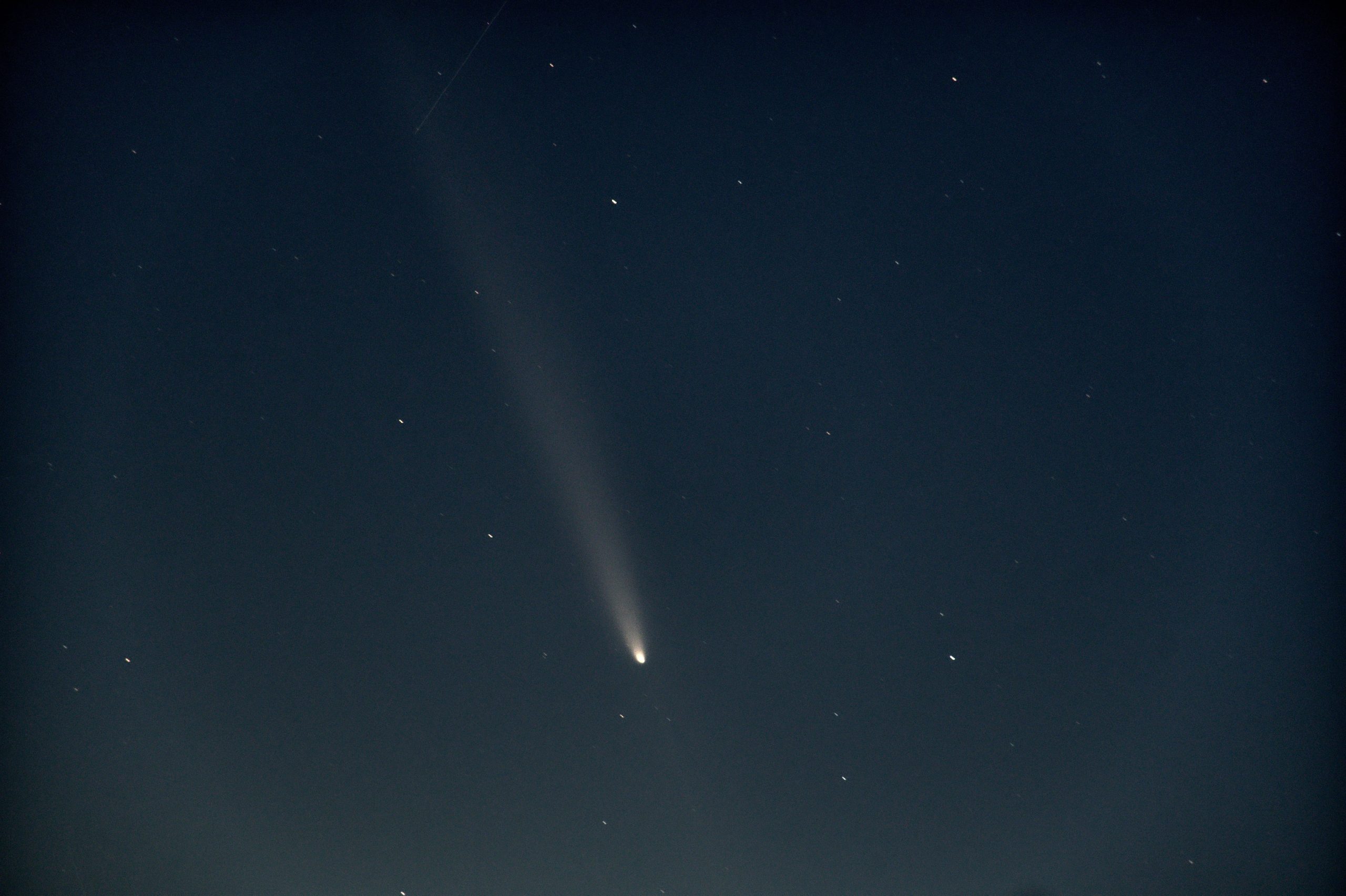
Recent Close Encounter with Interstellar Object 3I/Atlas Near Mars: Analyzing the Observations
In recent astronomical developments, the interstellar object designated 3I/Atlas made a close approach to Mars, offering scientists and enthusiasts a unique opportunity for observation. This celestial body passed near the Red Planet just minutes ago, and initial images were captured by NASA’s Perseverance rover during Sol 1643.
Understanding 3I/Atlas
3I/Atlas is recognized as an interstellar object—meaning it originated outside our solar system and traveled through it before its recent passage. It was first discovered in 2019 and has since been the subject of scientific interest, owing to its unique trajectory and surface properties.
Recent Observations from Mars
Perseverance’s imaging efforts have provided valuable data, capturing the object at its closest point to Mars. These images contribute to ongoing research into the characteristics and origin of 3I/Atlas. The observations help refine our understanding of how interstellar objects move and what they might reveal about other planetary systems.
Official Classification and Scientific Context
Currently, space agencies like NASA classify 3I/Atlas as a comet, citing its hyperbolic orbit—indicative of its interstellar origin—and its physical properties consistent with cometary bodies. It’s important to note that such celestial objects are typically characterized by their trajectory and compositional analysis obtained through spectroscopy and imaging.
Claims of Unusual Morphology
Recently, some speculation has emerged suggesting that 3I/Atlas exhibits a perfectly cylindrical shape, a form unlike typical cometary bodies. Such claims are not yet scientifically validated and remain speculative. While these descriptions generate curiosity and debate within the astronomical community, they should be understood as hypotheses rather than established facts.
Conclusion
The recent passing of 3I/Atlas near Mars presents a fascinating case for interstellar object study, highlighting the importance of ongoing observation and analysis. As data continue to be collected from Perseverance and other observational platforms, our understanding of these interstellar visitors will deepen, potentially offering insights into objects from beyond our solar system.
Disclaimer: While intriguing claims about the physical shape of 3I/Atlas are circulating, no conclusive evidence has confirmed it to be anything beyond a natural celestial body. Scientific consensus remains based on empirical data and peer-reviewed research.
Stay tuned for further updates on this exciting interstellar visitor as new data becomes available.