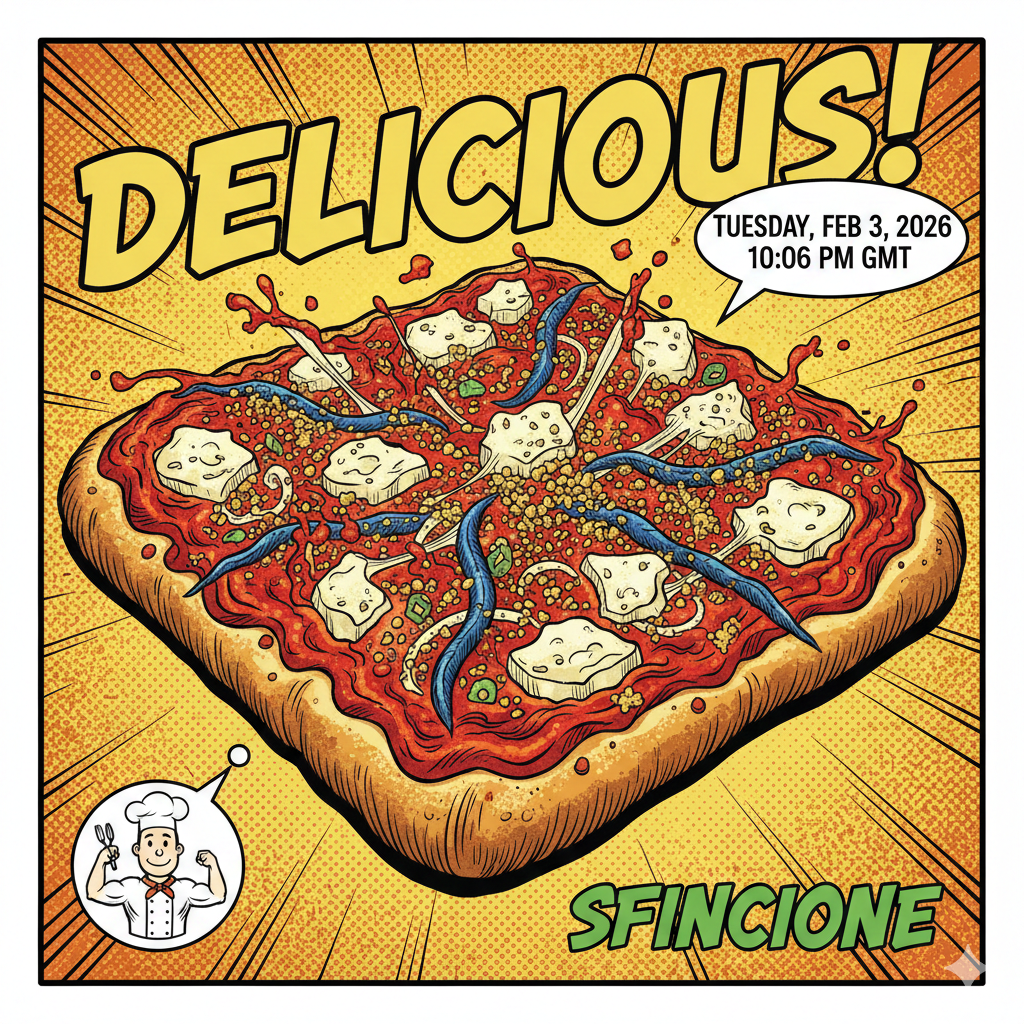
Sfincione (pronounced sfeen-CHOH-neh), or sfinciuni in Sicilian, is a thick-crust, rectangular pizza originating from Palermo, Sicily. Its name derives from the Latin word spongia and Greek sfincia, referring to its soft, airy, sponge-like texture. Often referred to as “the original” Sicilian-style pizza, it is a staple street food that differs significantly from Neapolitan pizza, typically featuring a savory, cooked-down sauce, aromatic toppings, and a distinctive breadcrumb finish.
Key Characteristics and Ingredients
- The Dough: It is a thick, fluffy focaccia-style dough that is soft on the inside but crispy on the bottom, often made with a mix of white flour and semolina.
- The Sauce: A cooked, robust, tomato-based sauce mixed with abundant sautéed onions, oregano, and anchovies.
- Toppings: Instead of large amounts of mozzarella, traditional sfincione is topped with a dusting of grated sharp cheese, usually Caciocavallo or Ragusano.
- Breadcrumbs: A key, defining feature is a topping of coarse breadcrumbs, which provides a crunchy contrast to the soft dough.
Regional Variations
- Sfincione Palermitano (Palermo): The most common, featuring the tomato, onion, and anchovy sauce.
- Sfincione Bianco (Bagheria): A popular “white” version, often made without tomato sauce, featuring extra onions, ricotta, or tuma cheese, along with anchovies.
Serving and Tradition
Sfincione is typically served in large rectangular trays, cut into pieces, and often eaten at room temperature, making it ideal street food. It was historically a festive dish, specifically prepared for Christmas Eve and New Year’s Eve, though it is now eaten year-round.
How it Differs from Regular Pizza
Unlike Americanized “Sicilian” pizzas that are often loaded with mozzarella, true sfincione is more about the savory, sweet-and-sour interplay of onions, anchovies, and olive oil. It is also characterized by a much higher, “spongier” crust.
When do people use the word ‘Monsignor’?
In the Roman Catholic Church, Monsignor is an honorary title granted to certain priests who have distinguished themselves through their service or have been appointed to specific high-ranking roles.
It is important to note that “Monsignor” is not a distinct rank of ordination (like deacon, priest, or bishop), but rather a title of distinction.
When the Title is Used
The title is typically used in formal address, correspondence, or to denote specific administrative positions within the Church hierarchy.
- Vatican Officials: Priests working in the Roman Curia (the Vatican’s governing body) often receive the title.
- Diocesan Recognition: A Bishop may request the Pope to grant the title to a priest in his diocese for long-term excellence or leadership (though Pope Francis restricted this in 2014 to priests at least 65 years old).
- Specific Roles: Certain positions automatically carry the title, such as a Vicar General or a Judicial Vicar.
How to Address a Monsignor
While the specific etiquette can vary depending on the level of the honor, the general rules are as follows:
| Context | Form of Address |
| Formal Writing | The Reverend Monsignor [First & Last Name] |
| Formal Introduction | Monsignor [Last Name] |
| Direct Conversation | “Monsignor” or “Monsignor [Last Name]” |
| Email/Letters | “Dear Monsignor [Last Name],” |
Changes in Recent Years
In 2014, Pope Francis adjusted the criteria for the title to reduce “careerism” within the clergy. He abolished the two higher grades of the honor for priests who are not in the Vatican’s service and limited the remaining grade (Chaplain to His Holiness) to priests over the age of 65. Consequently, you may see the title used less frequently among younger clergy today.
When would an American use it?
In the United States, the use of “Monsignor” is more restricted than in many European or Latin American countries. While it sounds like a general term for a high-ranking official, Americans use it in very specific ways:
1. Only for “Honored Priests” (Not Bishops)
This is the biggest difference. In countries like Italy, Spain, or France, “Monsignor” (or Monseñor/Monseigneur) is the standard way to address a Bishop.
- In the U.S.: An American would almost never call a Bishop “Monsignor.” They would say “Bishop [Name]” or “Your Excellency.”
- The American “Monsignor”: In the U.S., the title is reserved exclusively for priests who have been given a special honorary title by the Pope. It’s essentially a “lifetime achievement award” for a long-serving or high-achieving priest.
2. In Parish Life
If your local pastor is a Monsignor, the congregation will switch from calling him “Father” to “Monsignor.” * Socially: It’s used as a sign of deep respect for his years of service.
- Formally: You’ll see it on the parish bulletin, the sign outside the church, and in official wedding or funeral programs (e.g., “Celebrant: Rev. Msgr. John Smith”).
3. Administrative Contexts
You are likely to hear the word used by Americans involved in Church administration (the “Chancery”). Because the title is often given to priests who hold high-level jobs—like the Vicar General (the Bishop’s right-hand man) or the head of the marriage tribunal—it functions as a professional title within the “corporate” side of the Church.
4. Formal Etiquette (Invitations and Envelopes)
In a secular context, an American would use “Monsignor” primarily when addressing mail or making formal introductions.
- The Envelope: “The Reverend Monsignor [First & Last Name]”
- The Salutation: “Dear Monsignor [Last Name],”
Comparison at a Glance
| Context | American Usage | European/Latin American Usage |
| Addressing a Bishop | “Bishop” | “Monsignor” |
| Addressing a Priest | Usually “Father” | “Father” (unless titled) |
| Addressing a Monsignor | “Monsignor” | “Monsignor” |
Note: Because Pope Francis changed the rules in 2014, you will see fewer “new” Monsignors in America. Today, a priest usually has to be at least 65 years old to receive the honor, so the title has become a marker of a “senior” or “elder” statesman of the clergy.
Would it ever be used in jest?
Yes, Americans definitely use it in jest, though the humor usually relies on the contrast between the title’s extreme formality and a mundane or “un-holy” situation.
Because the title literally means “My Lord” and is associated with elderly, high-ranking, and often very traditional clergy, it carries a certain “weight” that is ripe for irony.
1. Mocking Self-Importance
If a friend is acting particularly bossy, pretentious, or acting like they are “above” the rest of the group, someone might call them “Monsignor” to take them down a peg.
- The Vibe: It’s a step up from calling someone “your highness.”
- Example: “Oh, I’m sorry, Monsignor. Should I bring your coffee to your throne, or will you be joining us commoners at the table?”
2. Poking Fun at “Old School” Behavior
Since the title is now mostly held by priests over 65, it is often associated with the “Old Guard” of the Church—men who are very formal, sticklers for rules, or slightly out of touch.
- The Vibe: Using it to tease someone who is being overly traditional or fussy about etiquette.
- Example: If a friend insists on wearing a full suit to a casual backyard BBQ, someone might say, “Look at you! You look like a regular Monsignor heading to a Vatican gala.”
3. Clerical “Inside Jokes”
Among Catholics (and even some priests themselves), the title is sometimes used to joke about someone’s career ambitions.
- The Joke: Since it’s an honorary title, calling a young, ambitious priest “Monsignor” can be a way of teasing him about being a “careerist” or a “ladder climber.”
- The Classic Joke: > Question: What did the Monsignor say to the Bishop?Answer: “Long time, no See.”(A “See” is a bishop’s jurisdiction, but it’s a pun on the fact that many Monsignors spend years waiting to be promoted to Bishop.)
4. Pop Culture Archetypes
In movies and TV, “The Monsignor” is often a trope for a cold, powerful, or slightly corrupt Church official (think Josh Brolin’s character in Knives Out or various characters in The Godfather). Americans might use the word in jest to describe anyone who seems like they are quietly pulling strings behind the scenes.
Summary of “Jesting” Contexts
- Sarcasm: To mock someone acting like a “lord.”
- Irony: To highlight how un-priestly someone is acting.
- Nostalgia: To tease an older relative who is very set in their formal ways.
Would you like to explore other religious titles that are used sarcastically, like “Your Eminence” or “The Grand Inquisitor”?