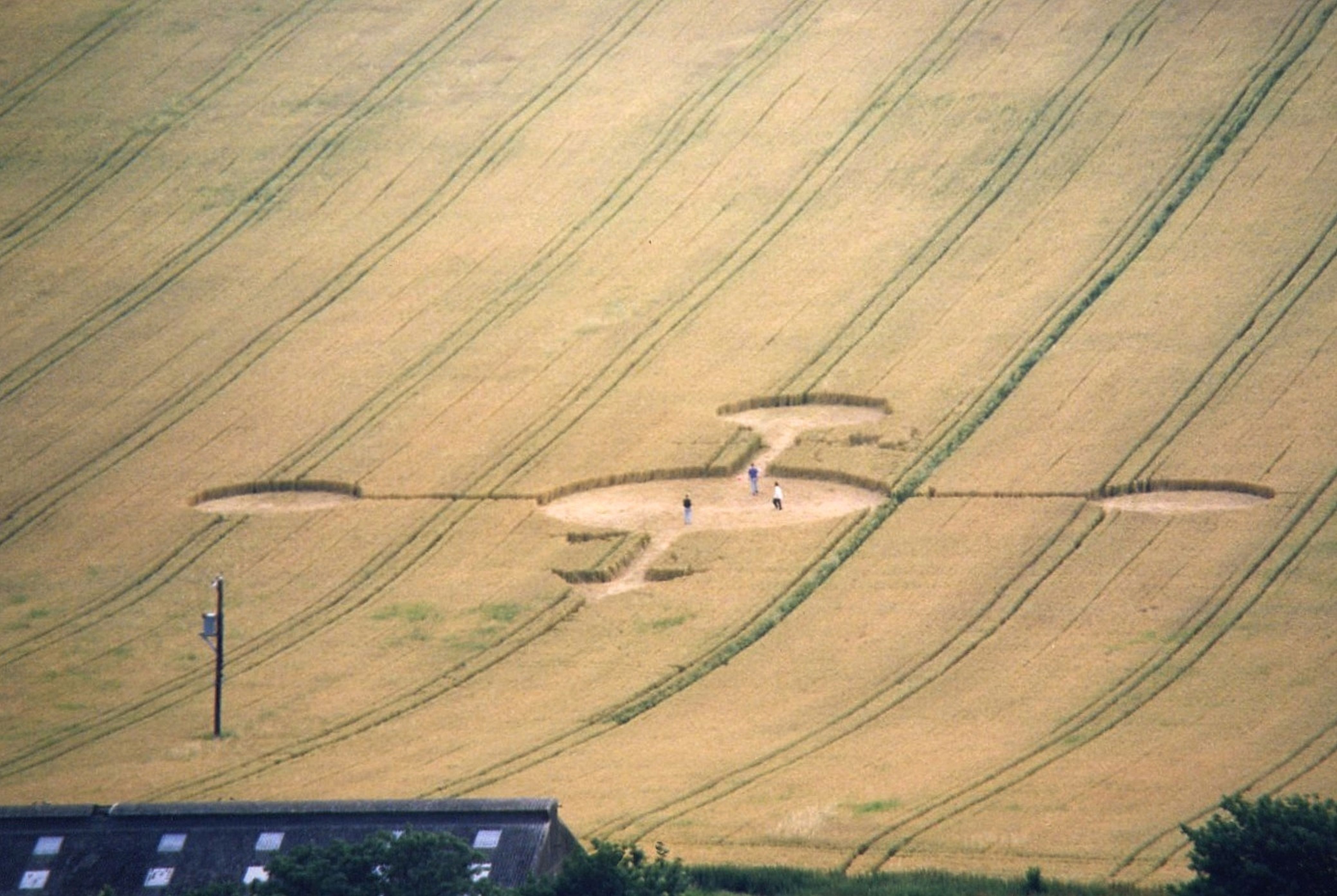
The geometry of the recent crop circle is perfect – I drew lines over a printed copy to check (2 photos)
The moment you hover your cursor over a blank address bar and type a single sequence of letters, the world tilts. A keystroke is more than intention; it is a fragile pledge to a vast, unseen choreography. In the span of a breath, your browser summons a constellation: DNS resolvers wake from slumber, root servers whisper, registries nod, and a tapestry of fiber and copper conducts your request across oceans. A trivial act—the simple, almost thoughtless tap of a key—unlocks a cascade of decisions, priorities, and promises that you do not see, yet you live inside every second of your online life.
The hook comes before we notice we’re hooked. You type in a URL as if you’re calling a familiar neighbor across a street you’ve never crossed physically. Your fingers move with practiced ease, choosing a domain that feels reliable, safe, even intimate—the human-friendly alias for a far more ruthless algebra of machines. Then, in milliseconds, the illusion dissolves into a map of protocols: a cascade of DNS queries, a chorus of server ranks, a routing table refined by millions of subroutines, and a network of routers negotiating congestion, latency, and policy. It feels like magic, but it is arithmetic—precision engineering hidden behind a curtain of user-friendly words.
Deconstructing the domain reveals its true anatomy. A domain is not merely a house on a street of the digital city; it is a global coordinate, a front door, a legal deed, and a cognitive anchor all braided into one. The moment we agree that example.com is a “thing” we can trust, we are acknowledging a social contract: a readable signpost that points to machines, policies, and people who administer trust at scale. The domain name system (DNS) is a metaphysical ledger, translating human language into a machine language that machines can navigate with the certainty of a compass needle. Every dot in a domain—the TLD, the subdomains, the serials—maps to a set of authoritative answers: who owns the address, who is authorized to serve it, who is allowed to switch the lights on when the color of the day shifts. It’s not just a house; it’s a promise encoded in cryptography, a deed filed with registries, and a covenant that your brand can be found, recognized, and defended across markets, languages, and devices.
This layer of abstraction—moving from numeric IPs to human language—was a civilization-changing choice. It allowed literacy to travel from books to browsers; it let brands breathe in a market of billions without forcing each citizen to memorize a fortressed address book of numbers. The human-friendly URL became a cognitive shortcut, a heuristic that makes the digital world navigable. In turning digits into semantics, we did more than simplify; we democratized access to a globe-spanning nervous system. A child’s curiosity could hunt for a page; a multinational company could marshal a storefront that resembles a trusted local shop in any language. And yet, beneath that readability lies an architecture of stakes: ownership, jurisdiction, identity, and sovereignty, all tethered to the discrete acts of registrars, registries, and the latent power of a root server.
Our collective blindness toward this infrastructure is almost artless in its normalcy. We assume the world wide web is a self-evident fabric—the “permission slip” of clicking a link that always works. We forget that billions of requests resolve around the world in real time because of an almost invisible coalition of registrars, root servers, TLD operators, recursive resolvers, and the physical spine of fiber that snakes under oceans. DNS is not a single organ; it is a democratic, distributed nervous system with a few core nodes that hold immense responsibility. The faith we place in those nodes is a trust we rarely examine: the faith that a registrar will renew a domain, a root server will stay coherent, a resolver will fetch the right answer, and the routing protocol will not re-route us into the storm of latency. We are passengers on a train we cannot see until the tunnel begins—the tunnel being the daily operation of this infrastructure, and the train the collective memory of a digital civilization that expects instantaneous access, even as it sails on fragile rails.
If you pause long enough to listen, you’ll hear an echo from the very first spark of the internet’s design: a design that sought to link distant machines through a shared language, while preserving autonomy, trust, and resilience. The domain name system embodies that duality. It is a decentralized chorus of authorities who must align their voices so users can arrive at the same place. It is the digital deed that signals ownership and consent in a realm where bytes travel faster than thought. It is the cognitive anchor by which brands hold steady as markets twist and technologies mutate. It is a cryptographic anchor because the integrity of a domain’s mapping—its association between the readable name and the numeric destination—depends on signatures, verifications, and a web of trust that can be contested, defended, or reimagined.
And yet the world treats domains as if they were natural terrain—like hills and rivers that always exist, weathered by time and traffic. We forget they are man-made, fragile, and high-stakes. We forget that the internet’s surface, the visible pages and apps, would crumble if the domain layer faltered. A misregistered renewal, a hijacked DNS record, a compromised registrar—these things echo through a global economy that has learned to assume seamless connectivity, but which is constantly balancing on the edge of friction. The most mundane action—the click of a link, the typing of a brand name, the memory of a password—depends on a delicate orchestration that is easy to forget until it breaks.
Consider the geometry of a domain more intimately. It’s a surface that resembles a city’s map: broad avenues of top-level domains, narrow streets of subdomains, cul-de-sacs of country-code domains, and the neon glow of content delivery networks that cache and shepherd data to where you are. It is also a bridge: a cognitive shortcut that lets you feel at home on a global platform, while your packets traverse undersea cables and satellite hops. The domain’s geometry is a compromise between human readability and machine tractability, a design that assumed trust in forms we could understand: registrars who vouch for identity, DNS records that can be queried with predictable syntax, and resolvers that can answer correctly, even when many steps separate you from the server.
The resolution of this meditation is not a technical manual, but a sobering invitation to wonder. When you type a domain and press Enter, you are participating in a centuries-long experiment with trust, language, and infrastructure. You are acknowledging that your digital real estate rests on a shared contract, a set of rules, and a chain of custody that can be audited, revised, or weaponized. You are conceding that the ease of modern browsing is built on a layer of discipline—an invisible nervous system—that must be tended, renewed, and guarded against corruption and failure. The internet does not guarantee permanence; it guarantees continuity through cooperation, redundancy, and the stubborn memory of a collective will to stay connected.
So, as you scroll, as you click, as you load another page that seems to arrive from nowhere, hold a moment of reverence for the ordinary. The crop circles of the digital world—the domains and their resilient, fragile architecture—aren’t merely technical artifacts; they are the geometry of trust we all stand upon. They remind us that convenience is not free, that readability is earned, and that the daily navigation of the web is a pilgrimage through a network of human choices, legal agreements, and physical infrastructures that have been engineered with care and contested with passion. The next time you type a URL, let the moment stretch a little longer. Listen for the quiet pulse of the invisible system that carries your request across the planet, and consider the notion that your online address is more than a location—it is a living artifact of a civilization’s willingness to believe in shared, navigable space.
In the end, the digital landscape invites wonder tempered with skepticism. It asks us to acknowledge the brilliance and the fragility of the constructs we treat as obvious, everyday terrain. Your browser’s address bar is not just a tool for convenience; it is a signpost to a vast, cooperative architecture. The geometry behind the URL is perfect because it must be—perfect enough to ferry your intent to a destination, imperfect enough to remind us that the voyage is a collective achievement. And for all the comfort it affords, it remains, at its core, a question: what else do we trust, and to what extent are we willing to defend, renew, and reimagine the invisible nervous system we call the internet?