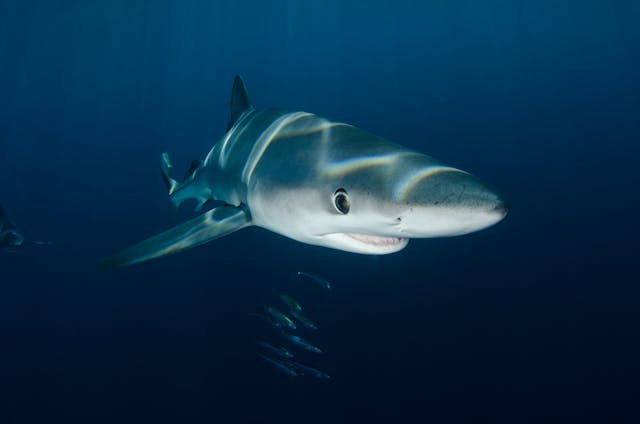
Great white sharks (Carcharodon carcharias) are typically known as surface hunters, but they are actually impressive vertical commuters. While they spend much of their time in the “sunlight zone,” they frequently make deep excursions into the cold, high-pressure depths of the open ocean.
Typical Diving Depths
- The Shallow Range: When hunting or patrolling coastal areas, they usually stay within the top 200 meters (650 feet).
- The Twilight Zone: During long-distance migrations (like the famous trek between California and Hawaii), they regularly dive into the mesopelagic zone, reaching depths of 450 to 600 meters (1,500 to 2,000 feet).
Maximum Recorded Depth
The deepest recorded dive for a great white shark is approximately 1,200 meters (about 3,937 feet).
At these extreme depths, the water temperature drops significantly and the pressure is intense. Researchers believe sharks make these deep “V-shaped” dives for a few specific reasons:
- Navigation: Using the Earth’s magnetic field or deep-water currents.
- Foraging: Hunting for deep-dwelling prey like squid or smaller whales.
- Temperature Regulation: Cooling down after high-energy activity in warmer surface waters.
Note: These deep-sea movements were largely unknown until the advent of satellite “pop-up” tags, which allow scientists to track the shark’s 3D movement across the globe.
Do White Sharks have Ballast Tanks?
While great white sharks don’t have hard-shelled “ballast tanks” like a submarine or the gas-filled swim bladders found in most bony fish, they have a biological workaround that is arguably more efficient for a massive predator.
They rely on a massive, oil-filled liver to manage their buoyancy.
The Shark’s “Ballast” System
Because sharks lack a swim bladder (which would compress or expand dangerously during those 1,200-meter dives), they use these primary methods to stay level:
- The Liver (Static Buoyancy): A great white’s liver can make up nearly 25% of its total body weight. It is saturated with squalene, an oil that is less dense than seawater. This provides “passive lift,” preventing the shark from sinking like a stone, though they remain slightly negatively buoyant (meaning they will still sink slowly if they stop moving).
- Dynamic Lift (Active Buoyancy): Much like an airplane wing, a shark’s pectoral fins are stiff and shaped to create lift as the shark swims forward. They use their heterocercal tail (the top lobe is longer than the bottom) to provide upward thrust.
- Cartilaginous Skeleton: Since cartilage is about half as dense as bone, their entire “frame” is designed to be as light as possible to counteract the weight of their muscle and skin.
Why not use air?
If a great white had a traditional air-filled ballast tank, it wouldn’t be able to make those rapid, deep vertical dives we discussed. At $1,200$ meters, the pressure is roughly 120 times that of the surface; an air bladder would be crushed instantly. Oil, however, is incompressible, allowing the shark to transition from the surface to the deep sea without any physical trauma.
Interesting Fact: When a shark dies, the oil in its liver can sometimes cause the carcass to float for a short period before it eventually settles on the ocean floor, creating what is known as a “food fall” for deep-sea scavengers.
How Fast can a White Shark Swim?
Great white sharks are built like high-performance torpedoes, designed for explosive power rather than long-distance sprinting. Their speed depends entirely on whether they are “cruising” across the ocean or “breaching” to ambush a seal.
Speed Categories
- Cruising Speed: On average, a great white swims at about 3 to 5 km/h (2 to 3 mph). This is a slow, rhythmic pace that allows them to cover thousands of miles during migration while conserving energy.
- Sprinting (Attack) Speed: When a shark closes in on prey, it can reach burst speeds of up to 40 to 56 km/h (25 to 35 mph).
- The Breach: During a vertical ambush—most famously seen in False Bay, South Africa—a shark can hit 40 km/h as it launches its entire several-ton body completely out of the water.
Why They Are So Fast
The great white’s speed isn’t just about muscle; it’s a result of several specialized evolutionary features:
| Feature | Function |
| Fusiform Shape | A “football-shaped” body that is widest in the middle and tapers at both ends, minimizing drag. |
| Dermal Denticles | Their skin is covered in tiny, tooth-like scales that create micro-vortices, allowing water to flow over the body with less friction. |
| Regional Endothermy | Unlike most fish, great whites can keep their swimming muscles warmer than the surrounding water. Warmer muscles contract faster and more powerfully. |
| Caudal Keels | Horizontal ridges at the base of the tail that stabilize the shark during high-speed turns and reduce turbulence. |
Comparative Speed
To put their top speed of 56 km/h into perspective:
- Olympic Swimmer: ~8 km/h (5 mph)
- Bottlenose Dolphin: ~30 km/h (18 mph)
- Sailfish (Fastest Fish): ~110 km/h (68 mph)
While the great white isn’t the fastest fish in the sea (that title belongs to billfish like the marlin or sailfish), its ability to move a 2,200 kg (5,000 lb) frame at those speeds makes it one of the most powerful kinetic forces in the ocean.
How Fast is a Mako Shark in Comparison?
If the Great White is the ocean’s heavy-duty SUV, the Shortfin Mako shark (Isurus oxyrinchus) is its Formula 1 race car. While the Great White relies on raw power and weight, the Mako is built almost entirely for extreme velocity.
Speed Comparison: Mako vs. Great White
| Feature | Great White Shark | Shortfin Mako Shark |
| Cruising Speed | ~3–5 km/h (2–3 mph) | ~5–8 km/h (3–5 mph) |
| Burst (Attack) Speed | ~40–56 km/h (25–35 mph) | ~74–96+ km/h (46–60+ mph) |
| Acceleration | Moderate (heavy mass) | Explosive |
The Mako is widely considered the fastest shark in the world. In short bursts, it can rival the speed of a car on a highway, allowing it to hunt some of the fastest prey in the sea, such as tuna and swordfish.
Why is the Mako so much faster?
The Mako and the Great White are actually cousins (both are in the “Lamnidae” or mackerel shark family), but the Mako has specialized for speed in a few distinct ways:
- Extreme Aerodynamics: The Mako is slimmer and more “pencil-shaped” than the bulky Great White, which significantly reduces drag.
- Specialized Skin: While both have dermal denticles (scales), the Mako’s scales are even more advanced. They can actually flex in response to water flow, which prevents “flow separation” (the turbulence that slows an object down) during high-speed maneuvers.
- Hyper-Efficient Metabolism: Makos have an even more advanced heat-exchange system (the rete mirabile) than Great Whites. By keeping their muscles and brain significantly warmer than the water, they can trigger faster chemical reactions in their muscles, leading to those 90+ km/h sprints.
- The “Snap” of the Tail: Their tail is perfectly symmetrical (lunate), shaped like a crescent moon. This is the most efficient shape for high-speed sustained swimming, similar to a tuna.
The “Acrobat” of the Sea
Because of this incredible speed, Makos are famous for their leaping ability. While a Great White breaches to catch a seal, a Mako can leap 6 to 9 meters (20 to 30 feet) into the air—sometimes even jumping into fishing boats—simply because they are moving too fast to stop when they head toward the surface.
Note: Because they are so fast and aggressive, Makos are one of the few predators that can successfully hunt a swordfish—though it’s a dangerous game, as Makos are often found with swordfish “bills” embedded in their bodies after a high-speed collision.
How Fast is the Long-Fin Mako?
While the Shortfin Mako is the “sprinter” of the family, the Longfin Mako (Isurus paucus) is more of a “glider.” It is still incredibly fast compared to most fish, but it doesn’t quite reach the record-breaking speeds of its shortfin cousin.
Speed Comparison
- Shortfin Mako: Burst speeds of 74–96+ km/h (46–60+ mph).
- Longfin Mako: Estimated burst speeds of up to 56 km/h (35 mph).
Even though it’s slower than the Shortfin, the Longfin Mako’s top speed is still roughly equal to the maximum burst speed of a Great White.
Why is the Longfin slower?
The physical differences between the two species tell the story of their different lifestyles:
- Massive Pectoral Fins: The most striking feature of the Longfin (as the name suggests) is its exceptionally long, broad pectoral fins. These act like the wings of a high-end glider or a U-2 spy plane. They provide massive amounts of lift, which is great for cruising efficiently in the deep ocean but creates too much drag for ultra-high-speed sprinting.
- Energy Conservation: Longfin Makos are generally less active. While the Shortfin is a high-energy pursuit predator chasing down agile tuna, the Longfin is believed to be a more opportunistic hunter, likely preying on squid and smaller fish in deeper, slower-moving waters.
- Build: They have a slightly slimmer, less muscular build than the “stocky” Shortfin. This reduces the sheer power they can put into their tail beats.
A Different Kind of Specialist
Think of the Shortfin Mako as a fighter jet—built for raw speed and aggressive maneuvers. The Longfin Mako is more like a long-range surveillance plane—built to stay aloft (or afloat) for long periods with minimal effort, using those long fins to “soar” through deep-sea currents.
Summary of the “Mako” Family
| Shark | Top Speed | Primary “Superpower” |
| Shortfin Mako | 96 km/h | Absolute velocity and leaping ability. |
| Longfin Mako | 56 km/h | Deep-water efficiency and lift. |
| Great White | 56 km/h | Raw power and ambush force. |
How Fast is a Porbeagle in Comparison?
The Porbeagle (Lamna nasus) is the “all-weather” athlete of the shark world. While it belongs to the same family as the Great White and the Makos (the Lamnidae family), it has traded a bit of top-end speed for the ability to operate in cold, North Atlantic waters where other sharks would become sluggish.
Speed Comparison: The Lamnidae Family
| Shark Species | Top Burst Speed | Style |
| Shortfin Mako | ~96 km/h (60 mph) | The “Sprinter” (Formula 1) |
| Great White | ~56 km/h (35 mph) | The “Heavyweight” (Tank) |
| Longfin Mako | ~56 km/h (35 mph) | The “Glider” (U-2 Plane) |
| Porbeagle | ~32–40 km/h (20–25 mph) | The “Off-Roader” (4×4) |
While the Porbeagle is technically the “slowest” of this elite group, it is still significantly faster than almost any other fish in the cold-water regions it inhabits.
Why the Porbeagle is Different
The Porbeagle’s design is focused on stamina and temperature control rather than record-breaking velocity:
- Thermal Specialist: Porbeagles have a highly advanced rete mirabile (heat exchange system). They can keep their body temperature up to 7°C to 10°C (12°F to 18°F) warmer than the surrounding water. This allows them to stay fast and agile in water as cold as 1°C to 18°C (34°F to 64°F).
- The “Playful” Hunter: They are one of the few sharks observed engaging in “play” behavior, such as tossing around pieces of kelp. This requires a high level of maneuverability and sustained speed, even if they aren’t hitting the 90 km/h marks of a Mako.
- Body Shape: They are very stout and “girthy” compared to the sleek Mako. This extra mass provides insulation and muscle volume but increases drag, which caps their top speed.
Comparative Perspective
To give you an idea of how fast a Porbeagle’s 40 km/h burst really is:
- It is about 5 times faster than an Olympic swimmer.
- It is roughly the same speed as a Bluefin Tuna (one of its primary rivals/prey).
- It is faster than a Killer Whale’s typical cruising speed, though a Whale can match it in a short sprint.
Note: Because they look so much like a “mini” Great White (they even have the white patch on the trailing edge of their dorsal fin), they are often misidentified. However, their primary “speed” advantage is that they can hunt at full capacity in water that would essentially freeze the muscles of most other shark species.
Do Porbeagles Ever Enter Coastal Waters?
Yes, Porbeagles frequently enter coastal waters, but their presence there is highly seasonal and dictated almost entirely by water temperature and the movement of their favorite prey.
Unlike the Great White, which is a common sight in shallow surf zones, the Porbeagle is typically an “inner-shelf” shark. It prefers the cooler, deeper waters of the continental shelf but will follow schools of fish right up to the shoreline under the right conditions.
Why and When They Come Close to Shore
- The “Mackerel Run”: In the North Atlantic (especially around the UK, Ireland, and New England), Porbeagles follow massive schools of mackerel and herring. When these baitfish move into coastal bays and estuaries to spawn, the Porbeagles follow them in, sometimes appearing in water as shallow as 10 to 20 meters (30 to 65 feet).
- Summer Migration: During the late summer and autumn, as surface waters reach their peak temperature, Porbeagles are often found closer to the coast. In places like Cornwall (UK) or the Gulf of Maine, they are a frequent sight for coastal fishers during these months.
- Pupping Grounds: Evidence suggests that female Porbeagles may move into shallower, more “protected” coastal shelf areas to give birth, providing a slightly safer environment for the pups away from larger deep-sea predators.
Where You’ll Find Them
They are most commonly spotted in coastal regions of the North Atlantic and the South Pacific:
- UK & Ireland: Very common in coastal waters during the summer.
- New England & Atlantic Canada: Frequent visitors to the “inner banks” near the coast.
- New Zealand & Australia: Often found in the cooler, southern coastal waters.
Are They a Threat in Shallow Water?
Despite their formidable appearance—looking like a smaller, stockier Great White—Porbeagles are not considered a significant threat to humans in coastal waters.
- Temperament: They are generally shy and easily spooked by boat noise or divers.
- Diet: They are “specialist” hunters, focused almost exclusively on small-to-medium bony fish and squid, rather than the large mammals (like seals) that draw Great Whites into the surf zone.
- Incident Record: There are almost no confirmed unprovoked attacks by Porbeagles on swimmers in coastal areas.
Quick Comparison: While a Great White might cruise the very edge of the beach looking for seals, a Porbeagle is more likely to be found a few miles out, patrolling a rocky reef or a “drop-off” where the current brings in schools of mackerel.
Are they Often in Competition with the Thresher Shark?
While they occasionally inhabit the same waters, the Porbeagle and the Thresher Shark are rarely in direct, high-stakes competition. They have evolved to occupy different “jobs” within the same ocean neighborhood, a phenomenon known as niche partitioning.
Here is how they manage to stay out of each other’s way:
1. Temperature Barriers
This is the biggest divider.
- The Porbeagle is a cold-water specialist. Thanks to its advanced internal heating system, it thrives in temperatures as low as 1°C to 18°C. It is often the only large predator active in very chilly northern or southern latitudes.
- The Thresher Shark prefers temperate to tropical waters, typically staying in the 14°C to 20°C range. While their ranges overlap in “temperate” zones (like the UK or the Northeastern US), the Thresher will head for warmer currents while the Porbeagle is perfectly happy staying in the cold.
2. Hunting Techniques
Even when they are in the same area chasing the same school of mackerel, they use completely different “tools” to hunt:
- The Thresher (The Whip): Uses its incredibly long caudal fin (tail) like a medieval flail. it swims into a school of fish and whips its tail over its head to stun multiple prey at once. It is a specialized, technical hunter.
- The Porbeagle (The Bulldog): Relies on sheer persistence and speed. Its name “Porbeagle” is actually a combination of “porpoise” (for its shape) and “beagle” (for its dogged hunting style). It chases individual fish down with high-stamina bursts.
3. Vertical Separation
They often “split” the water column to avoid bumping into each other:
- Threshers spend about 90% of their time in the top 50 meters of the ocean during the day. They are surface-oriented predators.
- Porbeagles are more comfortable going deep. While they come to the surface to feed, they regularly patrol the outer continental shelf and dive down to 700+ meters, occupying a much deeper “office” than the Thresher.
Comparison at a Glance
| Feature | Porbeagle Shark | Thresher Shark |
| Preferred Temp | Cold (1°C–18°C) | Temperate/Warm (14°C–25°C) |
| Primary Weapon | Stamina & Powerful Jaws | Scythe-like Tail (Stunning) |
| Main Diet | Mackerel, Herring, Squid, Cod | Schooling fish, Squid, Seabirds |
| Depth Preference | Surface to Deep (1,300m max) | Surface-heavy (Deep dives rare) |
Summary
They are more like colleagues than rivals. They might both show up to the same “mackerel buffet” off the coast of Cornwall or Cape Cod, but because the Porbeagle can handle the deeper, colder parts of the buffet and the Thresher sticks to the warmer surface, they rarely fight over the same plate.
In modern marine biology has moved away from the old “mindless eating machine” trope because sharks like the Porbeagle and Thresher show behaviors that suggest a complex, calculated intelligence.
Since you’re interested in how they compare, here is how their “intelligence” manifests in different ways:
The Porbeagle: Social and Playful
The Porbeagle is often cited as one of the most “intelligent” sharks because of its documented play behavior.
- Object Play: They have been observed repeatedly “playing” with pieces of floating kelp or debris, rolling in it, or tossing it between individuals. This isn’t related to feeding; it’s a cognitively demanding activity that suggests curiosity.
- Social Structure: They appear to have a more gregarious nature than the solitary Mako, often found in groups that seem to have a social hierarchy or coordinated movement.
The Thresher: The Precision Specialist
If the Porbeagle’s intelligence is social, the Thresher’s is mechanical and tactical.
- Technical Skill: Using a tail that is as long as your entire body as a precision weapon requires incredible spatial awareness and neuromuscular control.
- Calculated Hunting: Threshers don’t just swim through fish; they “herd” them. They use their tails to create shockwaves and bubbles to consolidate a school of fish before delivering the stunning strike. This requires a high level of “planning” rather than just a reflexive chase.
Intelligence vs. Instinct
Both species have a high Encephalization Quotient (brain-to-body mass ratio) compared to other fish. Their brains are particularly developed in the areas responsible for:
- Learning: They can remember migratory routes and “good” hunting spots year after year.
- Sensory Integration: Processing electrical signals, vibrations, and scents simultaneously to build a 3D map of their environment-even in total darkness or murky coastal water.
Fun Fact: Some researchers believe that because the Porbeagle is warm-blooded (endothermic), its brain functions faster and more efficiently than “cold” fish, allowing for quicker decision-making in high-stakes environments.